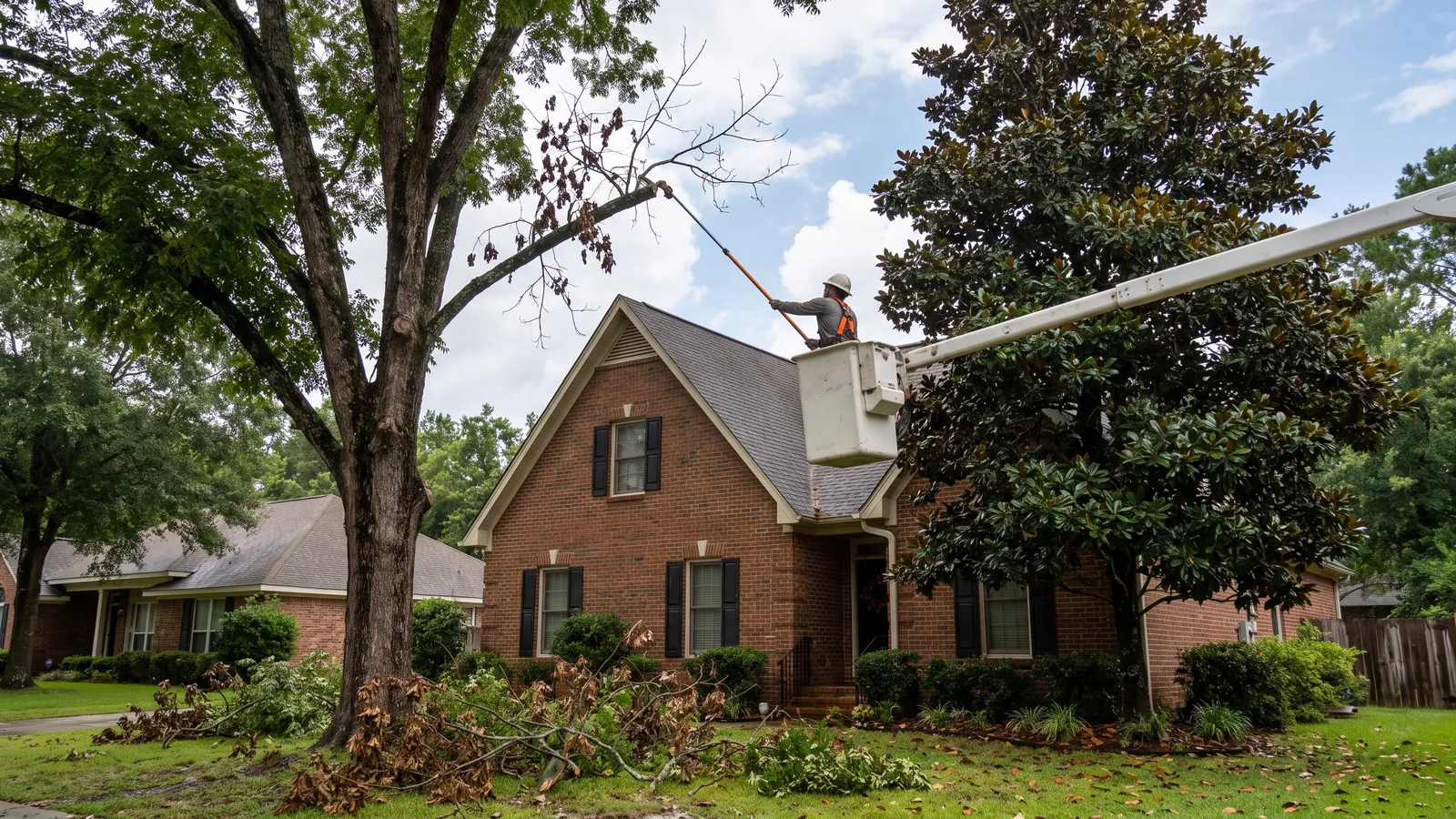
Trimming in Mobile is mostly about three things: taking out the dead and broken wood before a storm does, keeping limbs off the roof and out of the street, and shaping young trees so they grow a single strong trunk instead of a weak fork. The University of Florida's hurricane research puts it plainly: correct pruning is the most important part of helping trees survive hurricanes. Train young trees to one dominant trunk, shorten competing stems, remove dead and cracked branches, shorten overly long ones, thin the outer edge of the canopy rather than the interior, and get the low limbs off the roof. That is our standard prune.
What we won't do is top a tree. Topping, cutting the main limbs back to stubs, is the fastest way to turn a sound water oak into a hazard: the stubs rot, the sprouts that grow back are weakly attached, and the next storm breaks them off. The same goes for the annual "crape murder" that leaves crape myrtles as knuckled stubs every winter, and for lion-tailing, which strips the inside of a limb and leaves the weight at the end. The City's Urban Forestry rules for right-of-way trees require proper arboricultural practice, and we hold private trees to the same standard.
Timing varies by tree. Pecans and most hardwoods prune best in the dormant season. Magnolias take light pruning after they bloom. Crape myrtles want thinning, not stubbing, in late winter. Fruit trees in winter. Live oaks get their own page, here. And anything near Alabama Power's lines is the utility's job or a line-clearance-qualified crew's: the company's rule is that unqualified people stay 10 feet from overhead lines, and its contractors handle the 30-foot easement along distribution lines. We'll tell you when a limb is the utility's to cut and how to request it.
What's included
Deadwood and hazard pruning
Dead, cracked and rubbing limbs out, the ones that fall in a squall line.
Clearance
Limbs lifted off the roof, gutters, driveway and sidewalk, with the cuts placed at the branch collar.
Structural pruning for young trees
One dominant leader, competing stems shortened, so the tree grows up strong instead of forked.
Canopy thinning, outer edge
Thinned where the wind loads the tree, not gutted in the middle.
Never topping
No topping, no lion-tailing, no crape murder. If a tree needs that much taken off, we'll talk about removal instead.
Cleanup included
Brush chipped and hauled, lawn raked, photos sent.
Tree trimming cost in Mobile, AL
| Job | Typical price | Notes |
|---|---|---|
| Small ornamental or crape myrtle | $125 – $350 | Thinning, deadwood, shape |
| Medium tree, 30–50 ft | $350 – $900 | Pecan, magnolia, water oak |
| Large tree, over 50 ft | $800 – $2,200 | Climbed, roped over structures |
| Roof and gutter clearance, per tree | $250 – $700 | Limbs lifted off the house |
| Structural pruning, young tree | $100 – $250 | Best done in the first 10 years |
| Hangers after a storm, per tree | $200 – $600 | See storm cleanup |
These are 2026 Mobile-area ranges to help you budget. Your written price is itemized (climb or bucket work, rigging, chipping and haul-off, stump grinding, crane time, the City permit when one applies) and good for 30 days.
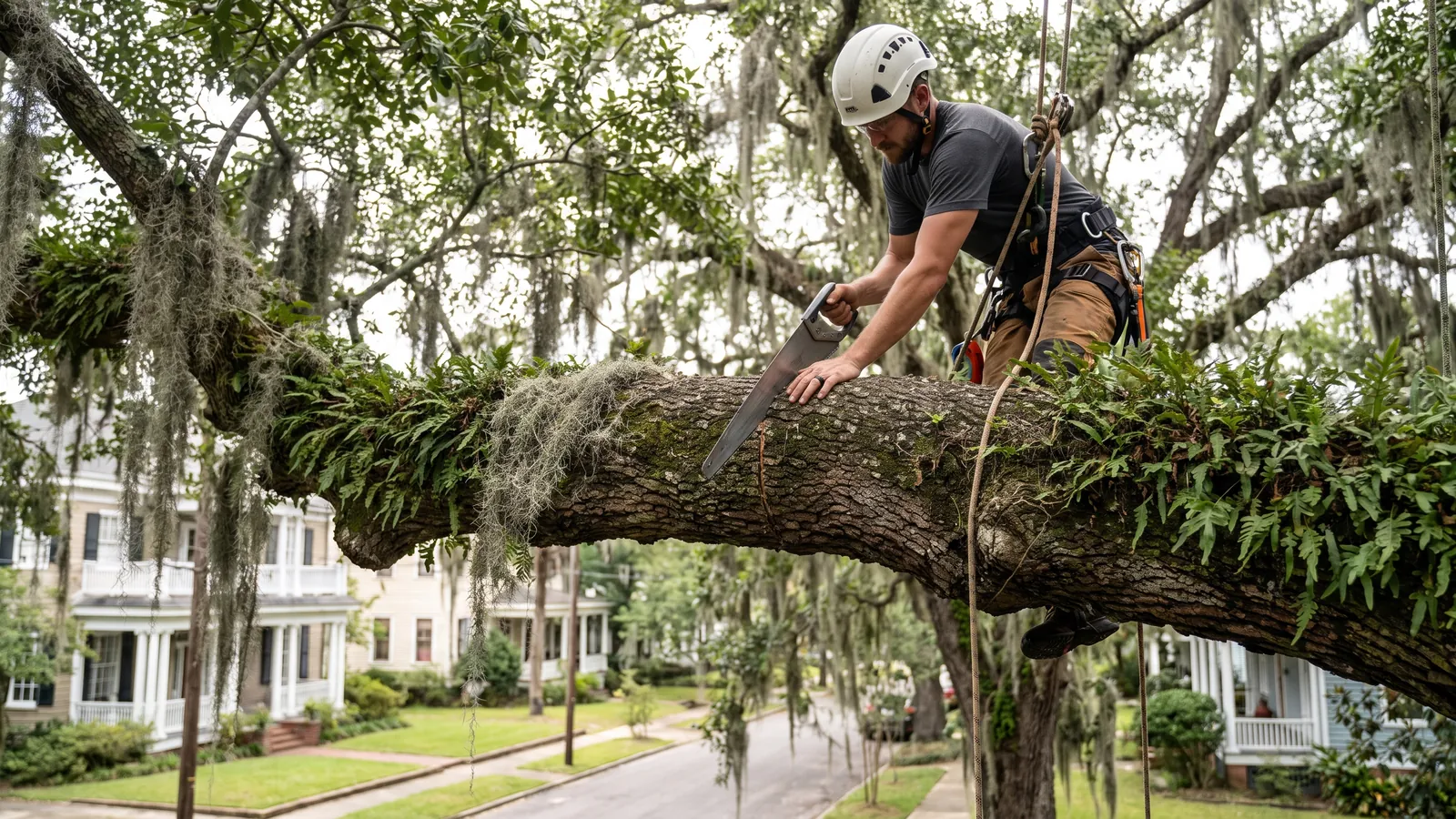
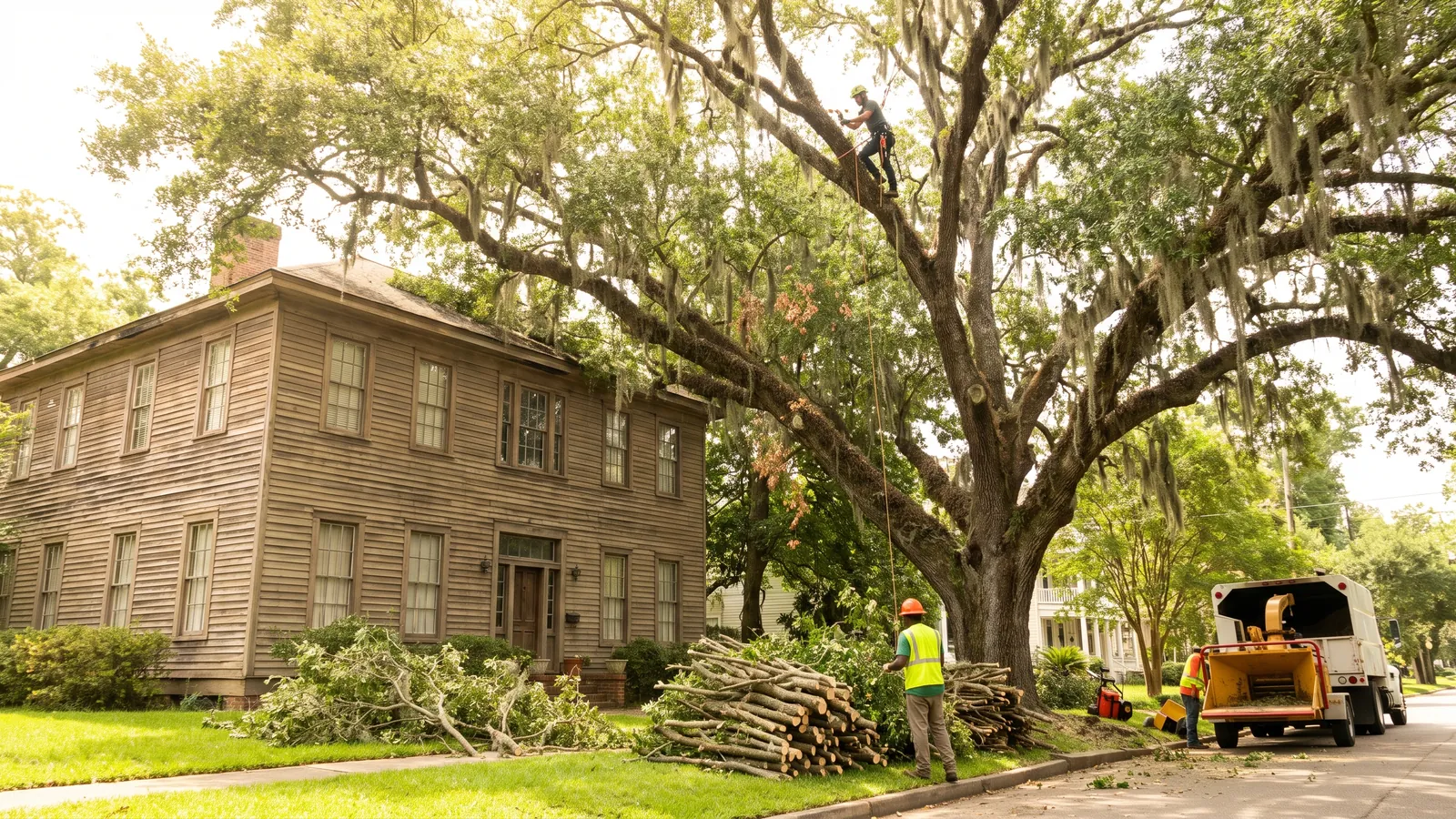
Recent work
Questions we get about tree trimming
When is the best time to trim trees in Mobile?
Late winter for most hardwoods and crape myrtles, after bloom for magnolias and azaleas, and any time before June 1 for hurricane-prep thinning. Deadwood can come out in any month. We avoid heavy pruning in the worst of the summer heat when it can wait.
Will you top my tree? It's too tall.
No. Topping makes a tree more dangerous, not less, and it looks terrible for years. If a tree is too big for its spot, the honest options are a proper reduction prune, which takes modest weight off the ends, or removal and a better-suited replacement.
What about the limbs over the power line?
Alabama Power and its contractors clear the distribution lines in a 30-foot easement, and only line-clearance-qualified crews may work within 10 feet of a line. You can request trimming through the utility's online form; a representative responds within 5 to 7 business days. We handle everything on your side of that clearance.
Can you trim my neighbor's tree where it hangs over my yard?
Generally you can have limbs cut back to the property line as long as it doesn't harm the tree, and we'll do that cleanly. Talk to the neighbor first; it goes better, and a tree straddling the line is shared property.
How often should trees be trimmed?
Young trees every two or three years while the structure is forming. Mature trees every three to five years for deadwood and clearance, and the University of Florida recommends a professional evaluation about every two years for trees near the house in hurricane country.
Do you prune fruit trees and citrus?
Yes. Satsumas, figs, pears and pecans in the dormant season, with the cuts that keep them productive. Citrus wants very little.