After the hurricane: what to do about your trees, in order
Mobile's storms come ashore in the dark and leave the trees for the morning. Here is what to do first, what can wait, how to tell a tree that will stand from one that has already failed, and what the City will and won't pick up.
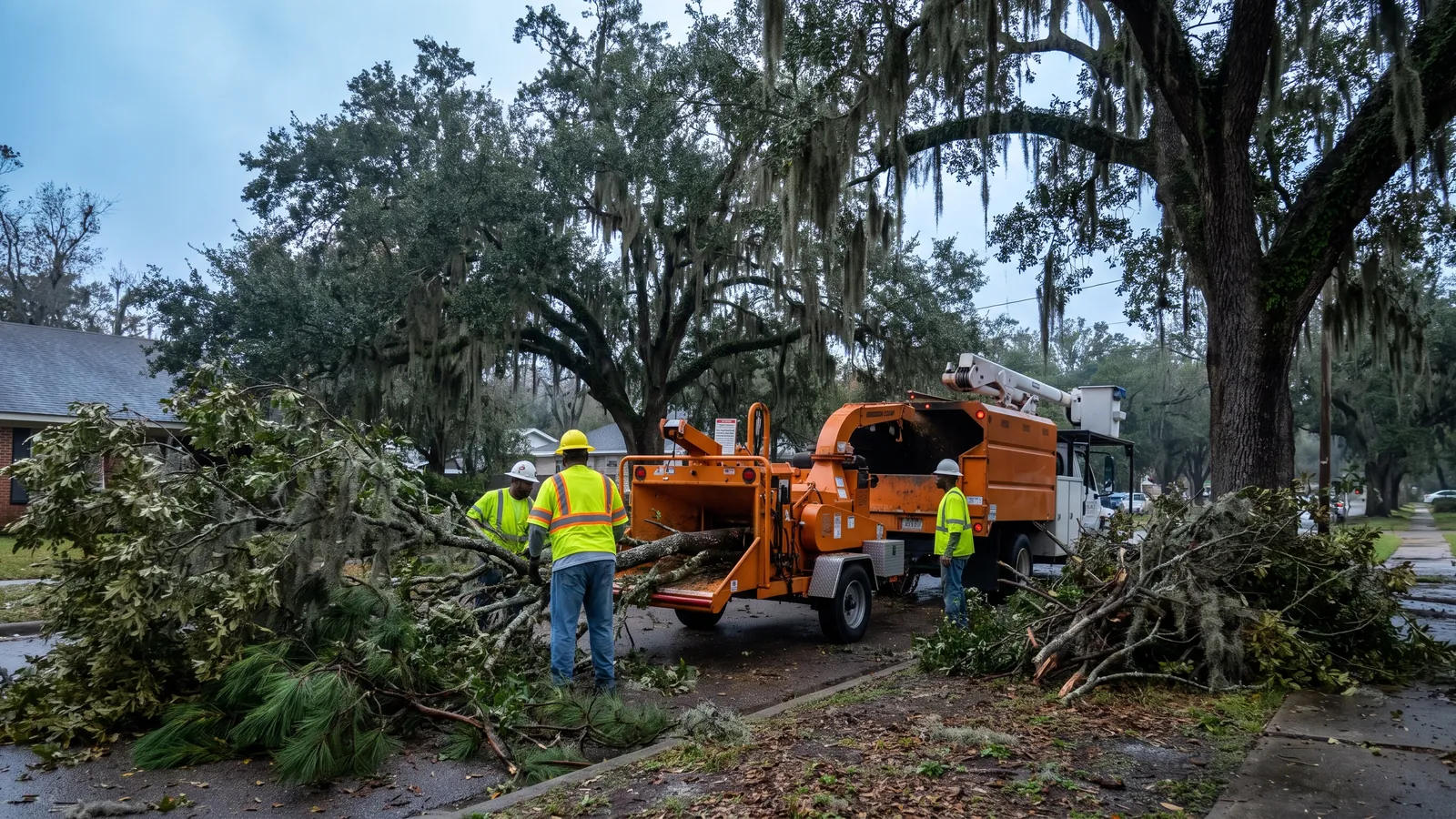
The first hours
People first. Get everyone out of the rooms under a tree that's on the house, and out of the house if the roof is open or the structure moved. Treat every downed line as energized; Alabama Power's rule is that only line-clearance-qualified crews work within 10 feet of a line, and a tree tangled in one is the utility's problem before it's anyone else's. Don't go on the roof. Don't let anyone with a chainsaw start on a tree that's loaded on a structure; the weight shifts when the first cut is made. Take photos of everything from a safe distance before anything is touched, because your insurer will want them. Then call: a tree on the house is a 24/7 emergency call, a tree blocking a city street after hours goes to Mobile Police at 251-208-7211, and Mobile County residents who need a roof tarp can call 211.
How to read a damaged tree
Dr. Beau Brodbeck, Auburn University's Extension specialist in community forestry, gave Mobile-area homeowners a short checklist after Sally, and it still holds:
- A leaning tree. Look at the ground on the back side of the lean. Mounded soil or exposed roots mean the root plate lifted, and the tree has already started to fail. His words: most trees cannot be straightened. If it's leaning toward anything that matters, it comes down.
- A cracked fork. A crack between the trunks of a forked tree is partial failure. The rest of the split is a matter of the next wind.
- Hangers. Look up. Broken limbs hanging or lodged in the canopy are what fall on people during cleanup, and they're the cheapest thing to fix.
- A split tree. Loss of large branches totaling roughly 30 to 50 percent of the tree's diameter means the tree is structurally compromised, not just ugly.
- Priorities. Budgets are limited. Deal first with the trees over high-value targets: the house, the driveway, the power lines, the places people walk. Remove large leaning trees over targets, remove or have evaluated trees with cracks or heavy branch loss, and hire an ISA Certified Arborist, which the City's own FAQ points to at treesaregood.org.
After Sally, Alabama's Urban Forestry Strike Team walked Foley and Gulf Shores marking trees with limbs at risk in white paint and trees needing removal with orange X's, and told residents to stay away from anything marked orange until crews got to it. If you see paint on a tree after a storm, that's what it means.
Pines, oaks and palms behave differently
The pattern on the Gulf Coast is consistent. Live oaks and sabal palms stand. The University of Florida's hurricane research lists the native live oak as a survivor species, and sabal palms bend and shed fronds rather than breaking. Pines fail, especially tall, slender pines that grew up in a stand and now stand alone, in sandy soil that goes soft under a foot of rain. Water oaks and laurel oaks split at hollow forks. Pecans drop whole limbs. So after a storm, the pines and water oaks get the attention, and the live oak with a few broken limbs usually just needs them cleaned up properly.
The debris
The City of Mobile's rules apply unless a storm program is announced. Limbs over 12 inches across or over 6 feet long are not collected as household trash. Curb piles are capped at 2 cubic yards (about 3 by 3 by 6 feet), and bigger residential piles are removed for a fee; call 208-5311 for an estimate. A pile set out more than 48 hours before the pickup day can draw a $532 fine, and so can blowing debris into the street or a storm drain or dumping it on a vacant lot. When a contractor does the work, the contractor is responsible for the debris. After a declared disaster the City and County may run a separate debris program with its own rules about separating vegetation from construction debris; after Nate in 2017, Mobile County didn't have enough debris to activate one and pointed residents to the landfills. We chip on site or haul to Chastang, Dirt Inc., H & S Land, Lott Road or Turkey Trott, depending on where you are. See the debris guide.
Insurance
Homeowners policies generally cover damage to the house from a fallen tree and the cost of getting the tree off the structure, within limits, and generally don't cover removing a tree that fell in the yard without hitting anything. A neighbor's tree on your house is usually your own insurer's claim unless the neighbor knew the tree was dead or dangerous. The University of Alabama's study of more than 40,000 Mobile and Baldwin County homes through Sally found nearly half the claims involved fallen trees, so adjusters here know the drill. Keep the photos, keep the invoice itemized, and don't sign anything from a door-to-door crew.
Mobile's storm record
- Frederic · September 13, 1979Category 4 over Dauphin Island, a 12- to 15-foot surge that reshaped the beaches, and the largest U.S. evacuation to that point, half a million people.
- Elena · September 2, 1985The eye hit Biloxi but the eastern eyewall raked the Alabama coast at 125 mph: roofs off, pines snapped, hours of wind across Mobile and Baldwin counties.
- Danny · July 19, 1997A Category 1 that stalled over Mobile Bay for a couple of days and dropped several feet of rain, especially on Baldwin County.
- Georges · September 28, 1998Category 2 near Biloxi, an 8- to 10-foot surge and 20 to 30 inches of rain across the area.
- Ivan · September 16, 2004Upper-end Category 3 just west of Gulf Shores at 1:50 a.m., 120 mph sustained, a 145-mph gust near Wolf Bay, a 10- to 15-foot surge that flooded downtown Mobile, and catastrophic tree damage inland.
- Katrina · August 29, 2005Category 3 at Buras and Waveland, the costliest hurricane in modern times, with surge and wind across the Mobile area.
- Nate · October 7, 2017Category 1 near Biloxi; not enough debris in Mobile County to trigger a pickup program.
- Sally · September 16, 2020Category 2 at Gulf Shores, 105 mph, crawling at 3 mph. 81-mph gust at Mobile Regional, 97 at Dauphin Island, 121 at Fort Morgan. Fairhope 12 inches of rain, Daphne 12.6, Foley 21, Orange Beach 30. More than 100 trees down in the city and 160,000 homes without power by that night.
- Zeta · October 28, 2020Category 2 south of New Orleans six weeks later, hurricane-force winds into west-central Alabama.
- Isaias · October 9–10, 2026Category 3 at sea, landfall on the western Florida Panhandle; Mobile and Baldwin counties under a Hurricane Warning with gusts of 55 to 75 mph, 3- to 6-foot surge and up to 6 inches of rain forecast.
Common questions
Should I cut the tree off my roof myself?
No. A tree loaded on a structure shifts when it's cut, and that's how people get hurt and how the rest of the roof comes in. Call us; it's dispatched first.
The tree is on the power line. Who do I call?
Alabama Power first. Treat the line as live. Once the utility has made it safe, we take the tree off the house.
How long will the wait be after a big storm?
Trees on structures and blocked driveways are dispatched as soon as the wind drops. General cleanup runs in the order calls came in, with priority for trees still hanging over something. After Sally the list ran for weeks; call early.
Can a leaning tree be saved?
Rarely. If the soil is mounded on the back side of the lean, the root plate lifted and the tree has failed. Auburn Extension's advice is that most leaning trees cannot be straightened.
Will the City pick up my limbs?
Only within its rules: nothing over 12 inches across or 6 feet long, piles under 2 cubic yards, set out no more than 48 hours before pickup. After a declared storm there may be a separate program. Contractor debris is the contractor's job, and we haul ours.
What if a crew knocks on my door offering to clear the tree for cash?
Get a written price, the company name, an ISA certification and a certificate of insurance before anyone starts. Storm chasers are a known problem after every Gulf landfall.
Related: Emergency tree service · Storm cleanup · Hurricane prep · Debris disposal · Insurance and financing