The short answer
Nationally, HomeAdvisor's June 2026 figures put the average tree removal at $750 with a typical range of $200 to $2,000, and large trees near power lines above $10,000. Mobile runs close to that for ordinary trees and above it for the two things this coast has a lot of: very tall pines and very big live oaks over close-set houses. For 2026 budgeting, a small tree under 30 feet runs about $250 to $600, a medium tree of 30 to 60 feet (most yard pines, water oaks and pecans) about $700 to $1,800, a large tree of 60 to 80 feet about $1,500 to $3,500, and a very large tree over the house, which usually means a crane, $2,500 to $5,500. Stump grinding is a separate line at $100 to $700 depending on size. The City's Tree Commission permit, when one applies, is $75 per tree.
Prices by job
| Job | Typical price | Notes |
|---|---|---|
| Small tree, under 30 ft | $250 – $600 | Crape myrtle, small pine, ornamental |
| Medium tree, 30–60 ft | $700 – $1,800 | Yard pine, water oak, pecan |
| Large tree, 60–80 ft | $1,500 – $3,500 | Big pine or oak, rigged in sections |
| Very large tree, over 80 ft or over the house | $2,500 – $5,500 | Usually with a crane |
| Dead or beetle-killed pine | + 20% – 40% | Bucket or crane instead of climbing |
| Live oak removal (rare) | $3,000 – $8,000 | Dense wood, wide canopy, permit likely |
| Palm removal | $400 – $1,500 | Height and access |
| Crane-assisted removal | $2,500 – $7,000 | No room to lower pieces |
| Emergency, tree on house (night/storm) | $600 – $1,800 call-out | Plus the removal; see emergency service |
| Stump grinding | $100 – $700 | Per stump, below grade |
| City Tree Commission permit | $75 per tree | Only when one applies; residential cap $225 |
What moves the number
- Size. Height and trunk diameter set how much wood there is to cut, lower and chip. An 80-foot loblolly has more wood than it looks, and a live oak's dense wood weighs twice what a pine's does.
- Condition. A living tree can be climbed and rigged normally. A beetle-killed pine is brittle and the U.S. Forest Service warns it's likely to fall even while standing, so it comes down from a bucket truck or with a crane, which costs more.
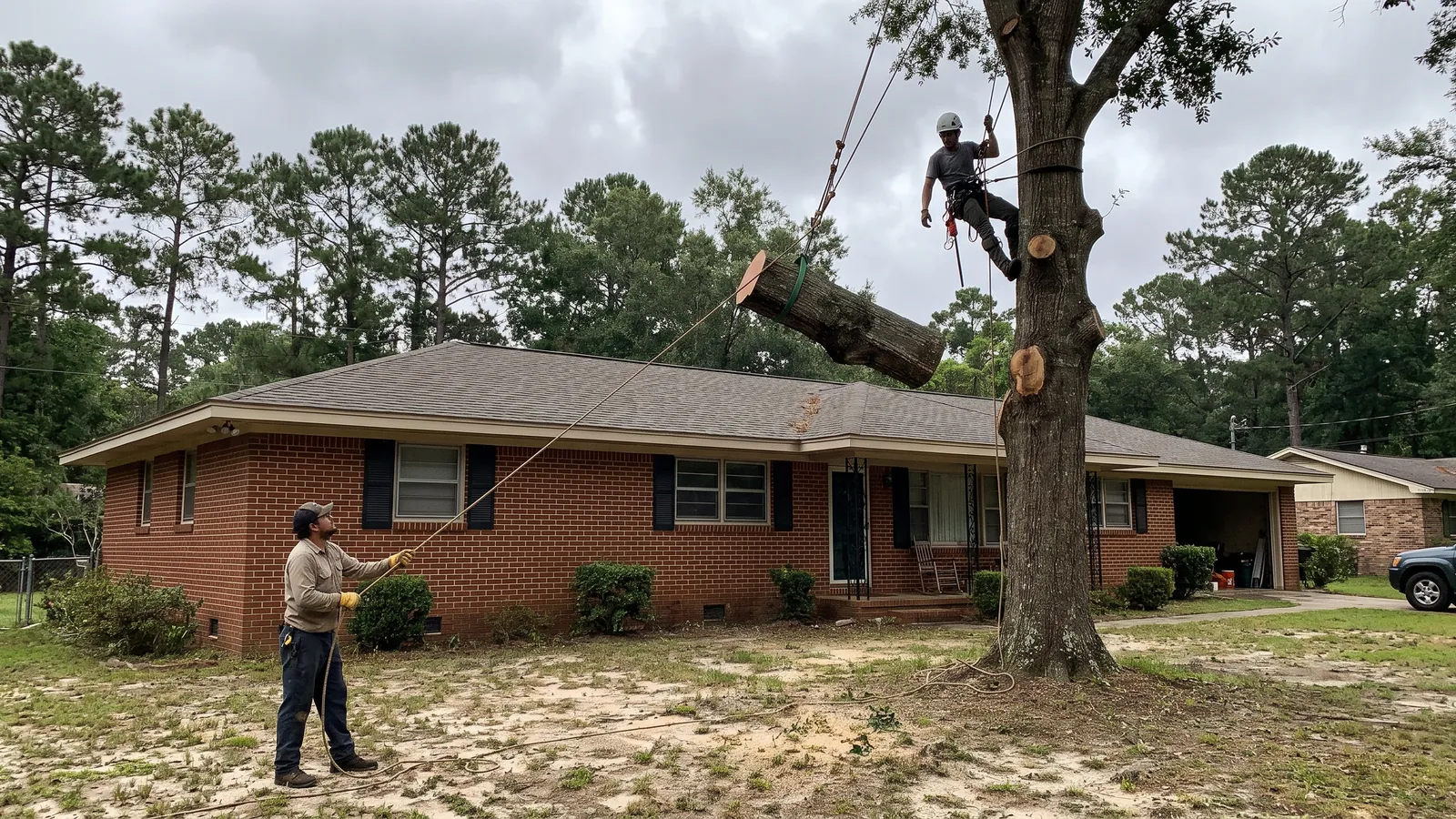
- What's under it. An open yard means the tree can be felled or dropped in big pieces. A tree over the house, the pool, a fence and the neighbor's oak comes down in roped sections, or by crane on a Midtown lot.
- Access. A bucket truck that can reach from the driveway is fastest. A backyard behind a fence with a narrow gate means climbing and carrying.
- Power lines. A service drop in the tree may need Alabama Power to disconnect it first. Trees in the distribution lines are the utility's job, and only line-clearance-qualified crews work within 10 feet of a line.
- Timing. Hurricane-night and storm-week work costs more because of the hour, the conditions and the demand. The same tree removed in February costs less than the same tree removed off a roof in September.
- The permit. $75 per tree for right-of-way trees, Heritage Trees of 8 inches or more in a historic district, and live oaks of 18 inches or more on undeveloped lots; nothing on a developed lot outside the historic districts.
- Stump and cleanup. Grinding, hauling the chips and backfilling with topsoil are separate lines so you can choose. Haul-off is included; the City won't collect limbs over 12 inches across or 6 feet long anyway.
Before the storm or after: the math
A leaning 70-foot pine beside the house costs roughly $1,800 to $4,500 to remove in the off-season. The same pine on the roof after a hurricane is a night call-out, a crane, a tarp, a roof claim and weeks of repairs. The University of Alabama's study of Hurricane Sally claims in Mobile and Baldwin counties found nearly half involved a fallen tree. For a pine over a target, removal before June 1 is almost always the cheaper number. See hurricane prep.
What a real quote includes
A written, itemized price good for 30 days. It should show the removal (method, and crane time if any), stump grinding and its depth, haul-off or what's left on site, cleanup and raking, the City permit if the tree needs one, and the company's certificate of insurance. Mobile's Code requires any permitted tree work to be done by a certified, licensed and bonded arborist; ask for the ISA certification and the insurance before anyone climbs, and be wary of door-to-door crews after a storm who want cash up front.
Common questions
Why is the stump a separate price?
Because not everyone wants it ground, and because depth changes the price. Grinding for grass is shallower than grinding to plant a new tree or pour a slab.
Does insurance pay for tree removal?
Usually when the tree hit something covered, like the house, within policy limits. A tree that fell in the yard without hitting anything is often not covered. Removal to prevent a future fall is not covered. We itemize so the adjuster can see what was done.
Is it cheaper to remove several trees at once?
Yes. Setup, chipping and haul-off are shared, so multi-tree days run 10 to 20 percent less per tree.
Can I save money by leaving the wood?
Some. If we buck the trunk into rounds and leave it, the haul-off line drops. Pine makes poor firewood but fine fire-pit wood.
Why does a live oak cost more than a pine of the same height?
Dense wood, a canopy that's wider than it is tall, and a trunk and limbs that have to be lowered in heavy pieces. And a live oak removal often needs a permit and a certified arborist. Most of the time we'd rather prune it.
How do I get a quote?
Call or send the form. An estimator walks the property, usually within a day or two, and leaves a written, itemized price.
Related: Tree removal · Pine removal · Crane removal · Stump grinding · Insurance and financing