Planting the trees that will still be standing in 2126
The pines that come out after every hurricane were the wrong trees in the wrong place. The replacement should be a tree that survives wind, sited where it can grow for a century without touching the house or the line.
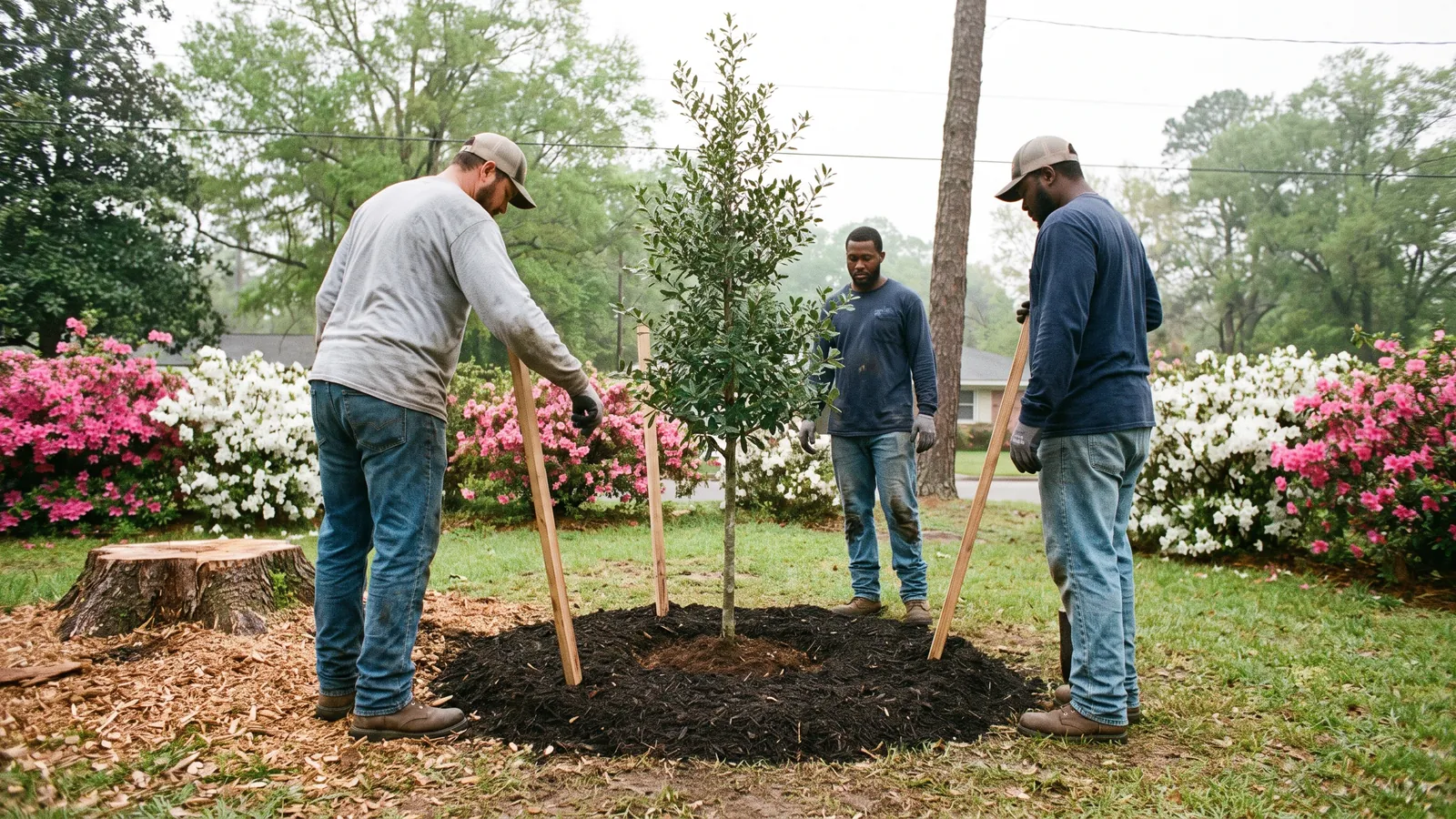
Every tree we take down in Mobile leaves a decision. The easy answer is nothing, and the lot gets hotter and plainer. The lazy answer is another fast pine or a water oak that will be hollow in 40 years. The right answer is a tree from the survivor list, sited properly. The University of Florida's hurricane research names the native live oak as a survivor species and recommends planting from its highest wind-resistance categories; on the Gulf Coast that list runs to southern magnolia, bald cypress, sabal palmetto and well-spaced longleaf pine. Nuttall and Shumard oaks are stronger choices than water oak where you want fast shade. Crape myrtle, redbud and yaupon holly fill the small spots.
Where it goes matters as much as what it is. Alabama Power's planting advice is to confirm the spot is outside the right-of-way, consider the tree's mature height and width, and call 811 before digging; its distribution lines carry a 30-foot easement, 15 feet each side, and a tree planted under one will be trimmed hard for the rest of its life. The same arithmetic applies to the house: a live oak wants 40 feet from the foundation, a magnolia 20, and nothing with a big root flare belongs over the sewer lateral or beside the driveway. The University of Florida also notes that trees planted in groups resist wind better than single trees, and that shallow roots from a high water table are a hazard, so we plant on the high ground of a lot, not the wet corner.
The planting itself is straightforward if it's done right: a wide, shallow hole, the root flare at or just above grade (never buried, which is the commonest mistake on the Gulf Coast's sandy soil), circling roots cut, backfilled with the native sand, a wide mulch ring that stays off the trunk, and stakes only where the site is windy and only for a year. Alabama 811 is called before the hole is dug, as the law requires. We leave watering instructions for the first two summers and come back in year two or three for the structural prune that sets up a single strong leader, the one cut that does more for hurricane survival than any other.
What's included
Survivor species
Live oak, magnolia, bald cypress, longleaf, nuttall oak and the right small trees, chosen for wind and for the spot.
Sited for a century
Away from Alabama Power's 30-foot easement, the foundation, the sewer lateral and the wet corner of the lot.
Alabama 811 before digging
Required by law; utilities marked before the hole goes in.
Planted at the right depth
Root flare at grade, circling roots cut, backfilled with native soil, wide mulch ring off the trunk.
Staked only if needed
And the stakes removed after a year.
Structural prune in year 2–3
One dominant leader, the cut that matters most in hurricane country.
Tree planting cost in Mobile, AL
| Job | Typical price | Notes |
|---|---|---|
| 1.5–2 in caliper tree, planted | $350 – $700 | Most yard trees |
| 2.5–3 in caliper live oak or magnolia, planted | $650 – $1,300 | Bigger start, more care |
| Sabal palmetto, planted | $400 – $900 | Field-grown, hurricane-cut at planting only |
| Stump grind and replant in the same spot | + $150 – $400 | Chips removed, topsoil added |
| Street-side (right-of-way) tree | Permit required | Tree Commission approval; we apply |
| Young-tree structural pruning, year 2–3 | $100 – $250 | Sets up a strong leader |
These are 2026 Mobile-area ranges to help you budget. Your written price is itemized (climb or bucket work, rigging, chipping and haul-off, stump grinding, crane time, the City permit when one applies) and good for 30 days.
Recent work
Questions we get about tree planting
What should I plant where the pine came out?
Something from the survivor list that fits the space: a live oak if you have 40 feet from the house, a southern magnolia or bald cypress for a mid-sized spot, a nuttall oak for fast shade, a crape myrtle or redbud near the house. Not another slash pine against the fence.
Can I plant a tree on the street side of the sidewalk?
That's City right-of-way, and planting there goes through the Mobile Tree Commission like any other right-of-way tree work. We handle the application.
When is the best time to plant in Mobile?
November through February, when the tree is dormant and the rain does the watering. Container trees can go in any month with enough water, but a tree planted in July needs daily attention.
How far from the house should a live oak be?
At least 40 feet, and 25 feet from the driveway. A live oak's limbs will reach 60 feet across and its roots further. Put it where it can be the biggest thing on the lot.
How much should I water a new tree?
Deeply, two or three times a week for the first few months in dry weather, then weekly through the first two summers. Mobile's rain helps, but a June dry spell on sand kills more new trees than anything else. We leave written instructions.
Do you plant under power lines?
Only small trees that top out under 20 feet, like crape myrtle, redbud or yaupon. Anything bigger under a line gets trimmed hard by the utility for life.